When we arrive at a hotel, we usually want two things: a quick check-in and the key to our room.
Behind the reception desk, the process looks different. Staff collect guest information, handle passports, enter data into hotel systems and complete official registration.
I travelled to Antalya for ATF Antalya 2026. It was my first hotel stay since we started building Misfora, and I decided to look at check-in from a new angle — not only as a guest, but as someone who builds document capture technology.
So I ran a small field test. I measured the check-in process at two hotels in Antalya, timing each one from the first greeting to the room key and watching how my passport was handled.
Hotel One: Two Minutes from Greeting to Room Key
At the first hotel, the whole check-in took two minutes. For a guest, that is a very good result.
The receptionist scanned my passport with a regular office scanner. My check-in form was already printed, and I did not need to sign anything.
A regular office scanner can capture a passport image, but it does not automatically turn that image into structured data. The document number, date of birth and other fields still need to be extracted from the image.
The printed form was already prepared. The booking held my name, stay dates and payment details — but not my passport information, which guest registration requires. The office scanner produced a passport image, so those details still had to be extracted or entered through another step.
So the two minutes I saw were the guest-facing part of the process. Turning that picture into a registration record is a separate step, and it happens out of the guest's sight.
One more detail. I arrived late, and the reception area was quite dark. Out of curiosity, I scanned my passport with the Misfora Web Scanner on my phone. It captured and read the document without any problems in that dim light.
This is one real-world case, not a comparison test. But it is the kind of condition a guest-side scanner has to handle: late arrivals, poor lighting and an ordinary phone.
Hotel Two: Four Minutes, Including 1 Minute 40 Seconds for Passport Data
To compare, I checked in at a second hotel. This time the whole process took four minutes.
The passport data stage took about 1 minute 40 seconds — roughly 42% of the total. The rest of the time the receptionist mostly checked the reservation and other details.
There was no scanner at all. The receptionist laid my passport open on the desk and typed my details into the registration form, field by field.
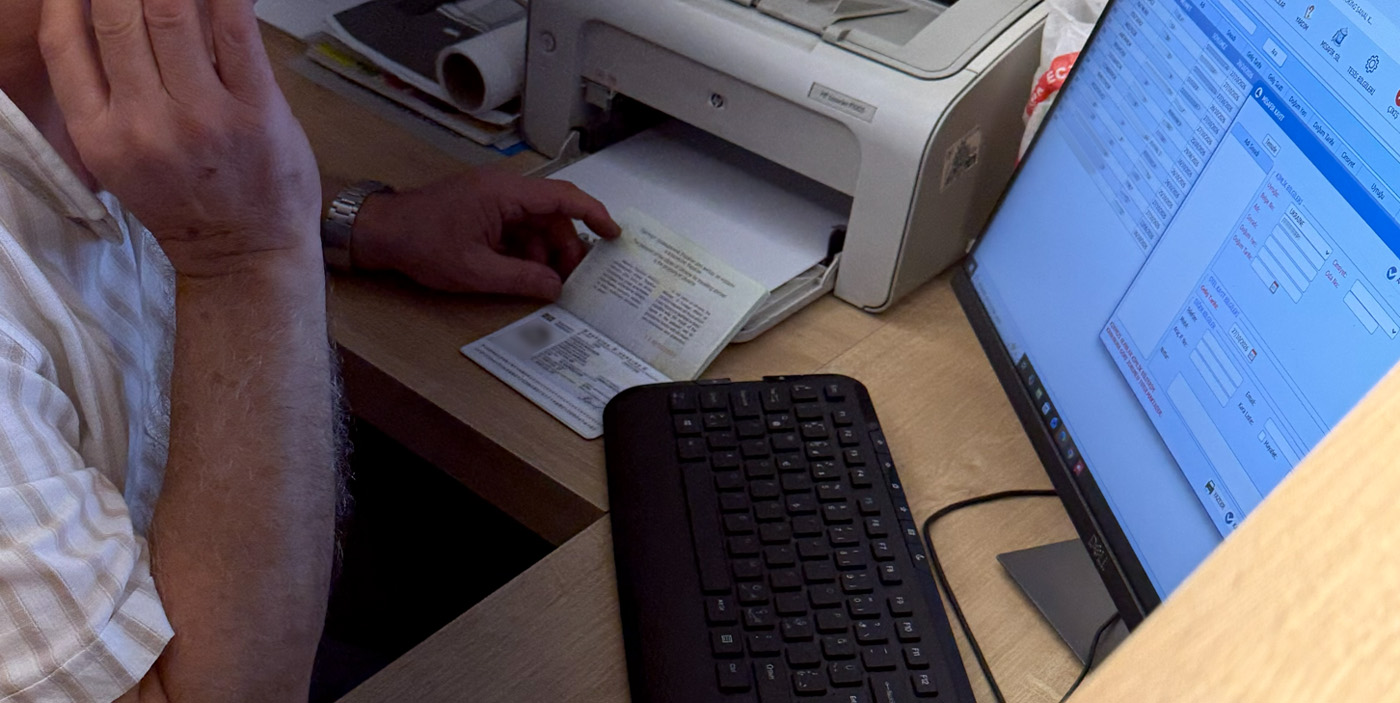
The software was not a full PMS. It was a simple web-based guest registration tool with a separate Kimlik Bildirim (identity notification) function for KBS. Next to it, guests were also recorded by hand in a paper log book.
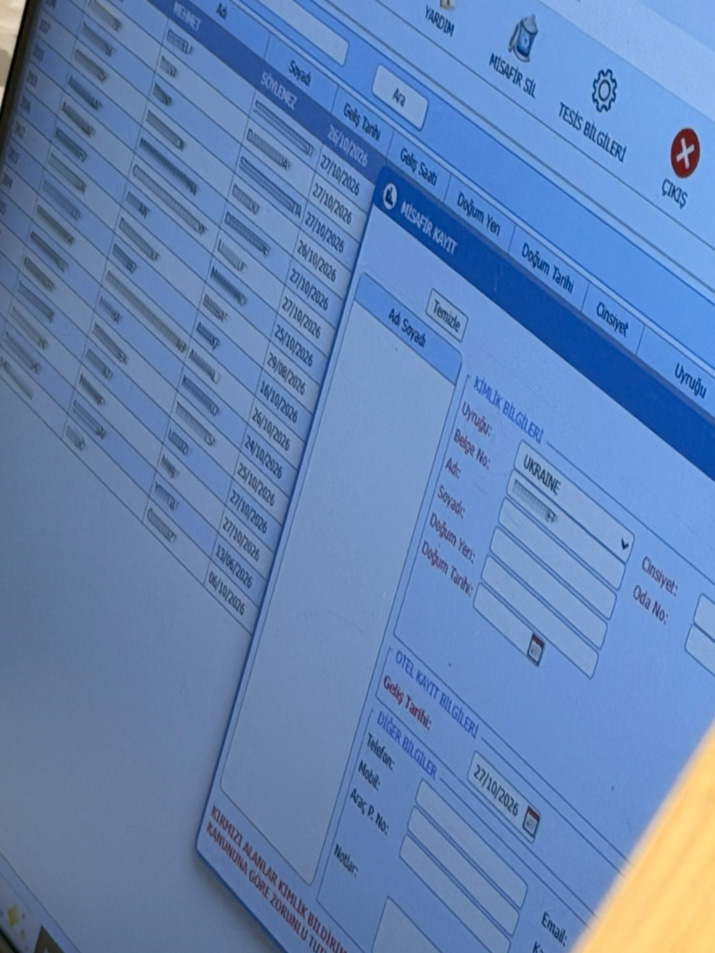
Later I saw that my name was misspelled in the paper log book. It was a concrete example of how manual transcription can introduce errors, especially when staff copy names from foreign passports.
| Hotel one | Hotel two | |
|---|---|---|
| Total check-in time | 2:00 | 4:00 |
| Passport handling | Office scanner; image file | Manual entry; about 1:40 |
| Form | Pre-printed; no signature required | Not recorded |
At the second hotel, passport data entry was a noticeable part of check-in, but not the largest part. About 1 minute 40 seconds went to passport data out of four minutes in total. The rest went to checking the reservation and other details.
That matters for realistic expectations about automation. Even if passport data took a few seconds instead of 1:40, the guest would still wait for the remaining steps. Document automation speeds up one part of check-in, not the entire process.
The two hotels also cannot be compared directly. They have different staff, systems and conditions. These are two observations, not a benchmark.
The Evening: Work That Starts After Check-In
The most interesting observation came later. In the evening, when almost no new guests were arriving, the receptionist was still busy with guest records: a paper log book, a computer and a printer.
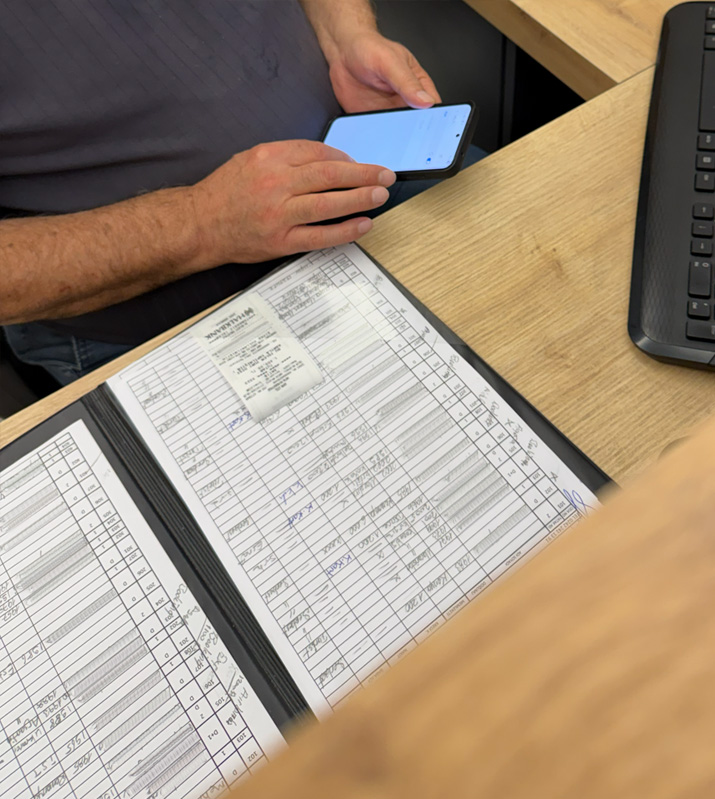
The work looked related to guest registration. In Türkiye, accommodation providers have reporting obligations through the Kimlik Bildirim Sistemi (KBS), although I could not confirm that this was the task being carried out that evening.
That changes the picture. The two or four minutes at the desk are not the full time a guest costs the hotel. Part of the work moves to quiet hours, or to another person on the payroll.
The two hotels showed two different approaches: one used an office scanner to capture a passport image, the other relied on manual data entry and a paper guest log. Two hotels cannot tell us how common either workflow is, but they show why the steps behind check-in are worth examining.
In Türkiye, accommodation providers are required to keep guest identity and arrival/departure records and make the required information available to the authorities in real time (Kimlik Bildirim Sistemi — Nevşehir İl Emniyet Müdürlüğü). This makes it important to understand not only how a document is captured, but also how its data reaches the registration system.
Separately, Türkiye's data protection authority has issued a decision against recording copies of Turkish national identity cards in the hospitality sector. Collecting the data needed for registration and retaining document images are different issues, and accommodation providers need to handle both appropriately.
What Happens When One Guest Becomes a Family of Three?
I checked in alone. But hotels often welcome couples, families and groups, and every guest has a document.
At the second hotel, passport data entry took about 1 minute 40 seconds for one guest. If the same time were required for each guest, the estimates would look like this:
| Guests | Estimated passport-data time |
|---|---|
| 1 | 1:40 |
| 2 | 3:20 |
| 3 | 5:00 |
| 4 | 6:40 |
If the passport-data step took the same amount of time for each guest, a family of three could require around five minutes for document handling alone. This is only a hypothetical estimate, not a measured result. Some information may already be available from the booking, and other steps may be shared across the reservation.
For the guest, a family check-in feels like one procedure. For reception staff, however, it may involve processing several individual identity documents alongside the reservation.
This matters most at small properties, where one person greets guests, answers the phone, checks bookings and handles registration. A few extra minutes per family is very visible there.
What We Still Don't Know
Two check-ins and one evening observation are a starting point, not a study. Several questions remain open:
- Where did the name in the electronic record come from? I saw the receptionist enter passport details manually, but I could not establish whether every field was typed from the passport or whether some information was already available from the booking.
- Is passport data entered twice? Once at check-in and again for KBS — or does one system pass it to the other?
- What exactly happens in the evening? I saw the receptionist working through guest records, but not which system received them.
- How long does the after-hours work take per guest? This is the cost guests never see, and the hardest to measure.
We plan to ask hotel owners and receptionists these questions directly. If you run a small hotel in Türkiye and want to share how your process works, message us.
Where Document Automation Can Help — and Where It Can't
This experiment changed how I describe what we build. The goal is not a faster room key. The goal is less hidden work around every guest.
Document automation can help with:
- Turning a passport into data, not a picture. Name, date of birth, nationality, document number and expiry are extracted as structured fields.
- Reducing manual data entry. Structured document data reduces the need to type passport details by hand. Where the same fields would otherwise be entered into several systems, an integrated workflow can also help avoid duplicate entry.
- Moving part of the process before arrival. Guests can scan their documents using a link on their own phones, reducing the need for reception staff to capture each document manually.
- Preparing data for registration. Structured document data can help staff prepare guest records for the required registration process. The exact workflow depends on the hotel's setup and integrations.
It cannot replace the reservation check, room assignment or the staff member who confirms the guest's identity. Those steps stay.
How Misfora Approaches This
- Misfora Hospitality — guest registration for hotels, apartments and villas: a check-in link for guests, passport and ID scanning, and KBS guest registration in Türkiye. It works with supported PMS or a Google Sheets booking workflow.
- Web Scanner SDK — browser-based document capture for PMS and travel software developers who want to add passport scanning to their own product.
- OCR API — document recognition that returns structured fields from a passport or ID image.
How much time this saves in a real hotel still needs to be measured on comparable documents and devices. That is our next experiment.
This field test was part of a wider look at the industry during the fair: what we learned at ATF Antalya 2026 about hotel document scanning.
Related Reading
- ATF Antalya 2026: What We Learned About Hotel Document Scanning and Guest Registration
- Why Good Document Capture Matters for OCR Accuracy — why OCR quality starts before recognition
- Misfora Hospitality · KBS guest registration in Türkiye · Google Sheets workflow
Misfora develops identity document capture, OCR and guest registration automation for hospitality businesses and software providers: the Web Scanner SDK, the OCR API and the Misfora Hospitality platform with PMS integrations, a Google Sheets workflow and KBS guest registration in Türkiye.